
Practical Software for Autonomous AI

Ward Agentic Research and Development is an independent studio founded by Thomas Ward. We build experimental, open-source software tools to solve real challenges with AI agents—preventing API rate limit crashes, protecting data privacy, stopping rogue commands, and optimizing datacenter cooling.

About Ward Agentic Research and Development

We are an independent software studio founded by Thomas Ward. We create practical, open-source software that helps developers and teams run AI agents smoothly and safely. Everything we build is tested on real hardware, published with permissive open-source licenses, and designed to solve everyday headaches like API rate limits, data privacy, and security risks.

Pillar 01 • Open Source

Open Source and Free to Build On

Our client libraries and developer tools use the permissive MIT License so you can integrate them freely. Our core server engines use Apache 2.0 to give you clear patent protection with zero vendor lock-in.

Pillar 02 • Hardware Security

Secured Directly on Your Hardware

Instead of trusting opaque third-party cloud servers, our tools run locally and use hardware features you already own—like Apple Silicon Secure Enclaves and Neural Engines—to verify data and run AI models privately.

Pillar 03 • Built-In Standards

Built-In Safety and Privacy Standards

We design our software to follow established security and privacy guidelines from day one, including NIST AI risk management, OWASP Top 10 for LLMs, and mathematical privacy proofs.

Our Four Flagship Software Systems

Four focused software tools built to solve specific challenges in agentic coding, data privacy, security defense, and datacenter efficiency. Each card includes simple explanations, technical specs, whitepapers, and full source code on GitLab.

macOS First-Launch & Security Notice

Encountering the prompt: “Apple could not verify [name of software] is free of malware that may harm your Mac or compromise your privacy”?

macOS Gatekeeper Guide

All software built by Ward Agentic R&D is 100% open source, auditable, and self-hosted. Because our binaries and disk images are distributed directly via GitLab rather than Apple’s closed App Store, macOS Gatekeeper will show an unverified developer warning upon initial launch. Choose any of the three simple methods below to run the software:

Option 1 • Fastest (GUI)

Control-Click & Open

In Finder, hold the Control key and click (or right-click) the application icon, then select Open. In the dialog box, click Open (or Open Anyway). You only need to do this once.

Option 2 • System Settings

Privacy & Security Settings

Open System Settings > Privacy & Security, scroll down to the Security section where macOS notes the app was blocked, and click “Open Anyway” to authorize execution.

Option 3 • Terminal (CLI)

Clear Quarantine Attribute

If downloading raw application bundles or archives, strip the macOS Gatekeeper quarantine flag in your terminal:

xattr -cr /path/to/AppName.app

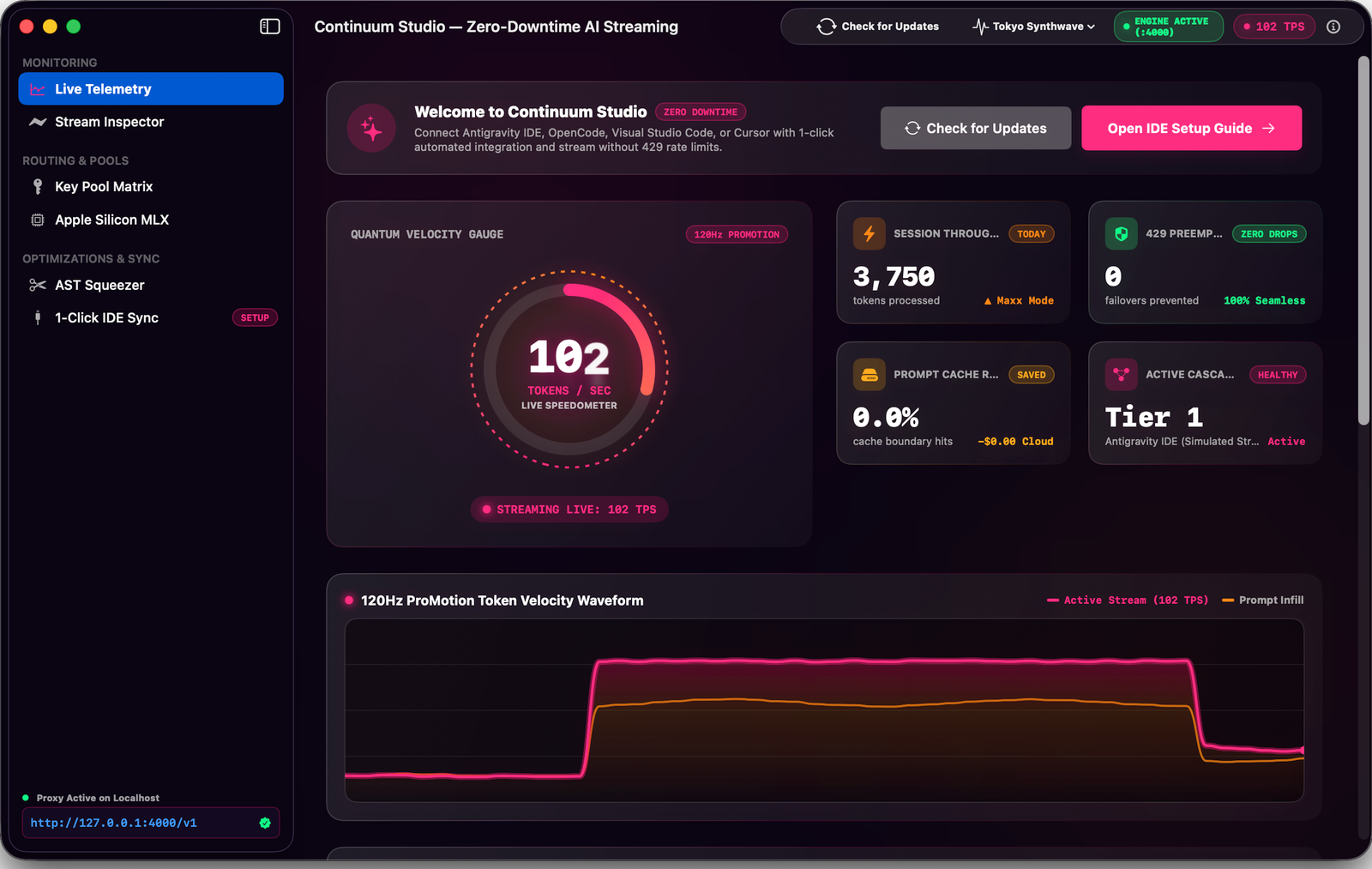
Continuum Studio

Local reverse proxy preventing AI rate limits
v2.5.1 macOS Universal MIT License
💡 In Plain English

If you use AI coding assistants like Cursor, Claude Code, or Antigravity, you know the frustration of getting hit with "429 Too Many Requests" errors. Continuum Studio sits quietly on your machine, automatically rotates across your backup API keys before you hit limits, and trims redundant comments and spacing so your prompts use fewer tokens.

🔬 Technical Specifications & Architecture
  • 429 Preemption: Dual-mode Token Bucket tracking with < 4ms speculative key rotation to prevent rate limits.
  • AST Compression: Semantic AST compressor stripping whitespace and comments for up to 38% token reduction.
  • Engine & Runtime: Swift 6 daemon built on Hummingbird 2 and SwiftNIO with local Apple MLX Metal 3 neural acceleration.
  • IDE Sync: Model Context Protocol (MCP 2024-11-05) standard with automatic configuration sync across 15 IDEs.
429 Preemption < 4ms Local Gating
AST Squeeze -38% Payload Size
IDE Compatibility 15 IDEs Auto-Synced
Local Compute Apple MLX Metal 3
Swift 6 SwiftUI Hummingbird 2 SwiftNIO Apple MLX Metal 3
🦊 GitLab Repository
📦 Releases & Quickstart All Releases ↗
⚡ Quickstart CLI
$ git clone https://gitlab.com/WardAgentic/continuum-studio.git
$ cd continuum-studio && git checkout v2.5.1
$ ./Scripts/package_dmg.sh 2.5.1 && open Continuum.app

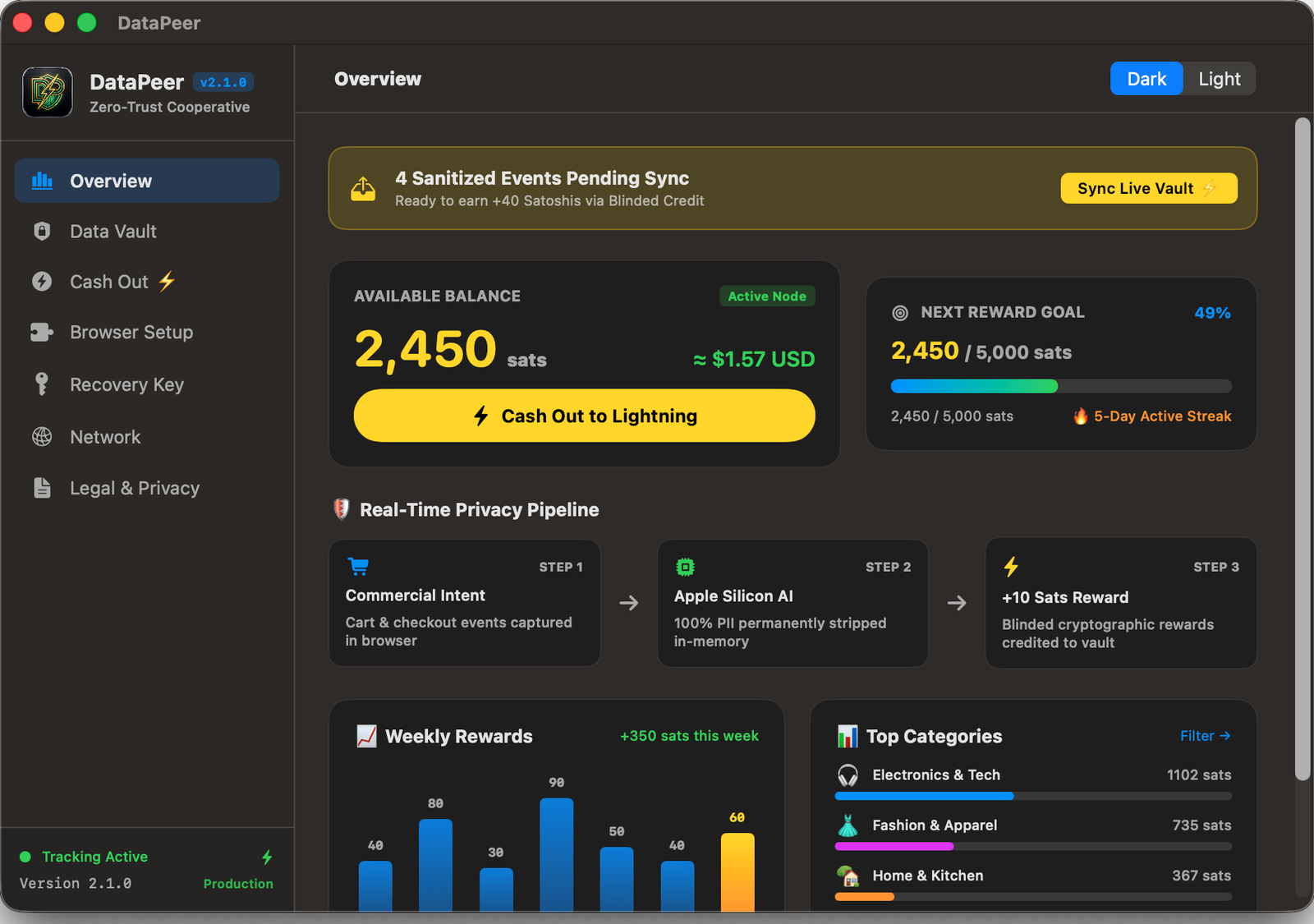
DataPeer

Private data cooperative with instant Lightning micropayments
v2.1.0 macOS 14+ Silicon Native Apache 2.0
💡 In Plain English

Big tech companies make billions tracking browsing habits, while users get nothing and risk their privacy. DataPeer automatically strips out all personal information on your device before data ever leaves your computer, groups it with others so you stay anonymous, and pays you instantly in Bitcoin over the Lightning Network.

🔬 Technical Specifications & Architecture
  • Local PII Stripping: On-device DOM sanitization using Apple NaturalLanguage NER before network transmission.
  • Differential Privacy: K ≥ 50 cohort suppression and calibrated Laplace noise (ε ∈ [0.1, 1.5]).
  • Hardware Attestation: Apple Secure Enclave P-256 ECC cryptographic signatures for tamper-proof telemetry.
  • Micropayments: Non-custodial Bitcoin Lightning Network (BOLT-11) settlement backed by JIT LSP liquidity channels.
Anonymity Floor K ≥ 50 Cohorts
Privacy Budget ε ∈ [0.1, 1.5]
Hardware Trust Secure Enclave
Settlement Lightning BOLT-11
Swift 6 SwiftUI Apple NaturalLanguage Secure Enclave P-256 BIP-39 Seeds LSP Client
🦊 GitLab Repository
📦 Releases & Quickstart All Releases ↗
⚡ Quickstart CLI
$ git clone https://gitlab.com/WardAgentic/datapeer_dashboard.git
$ cd datapeer_dashboard && git checkout v2.1.0
$ swift build -c release && open .build/release/DataPeer.app

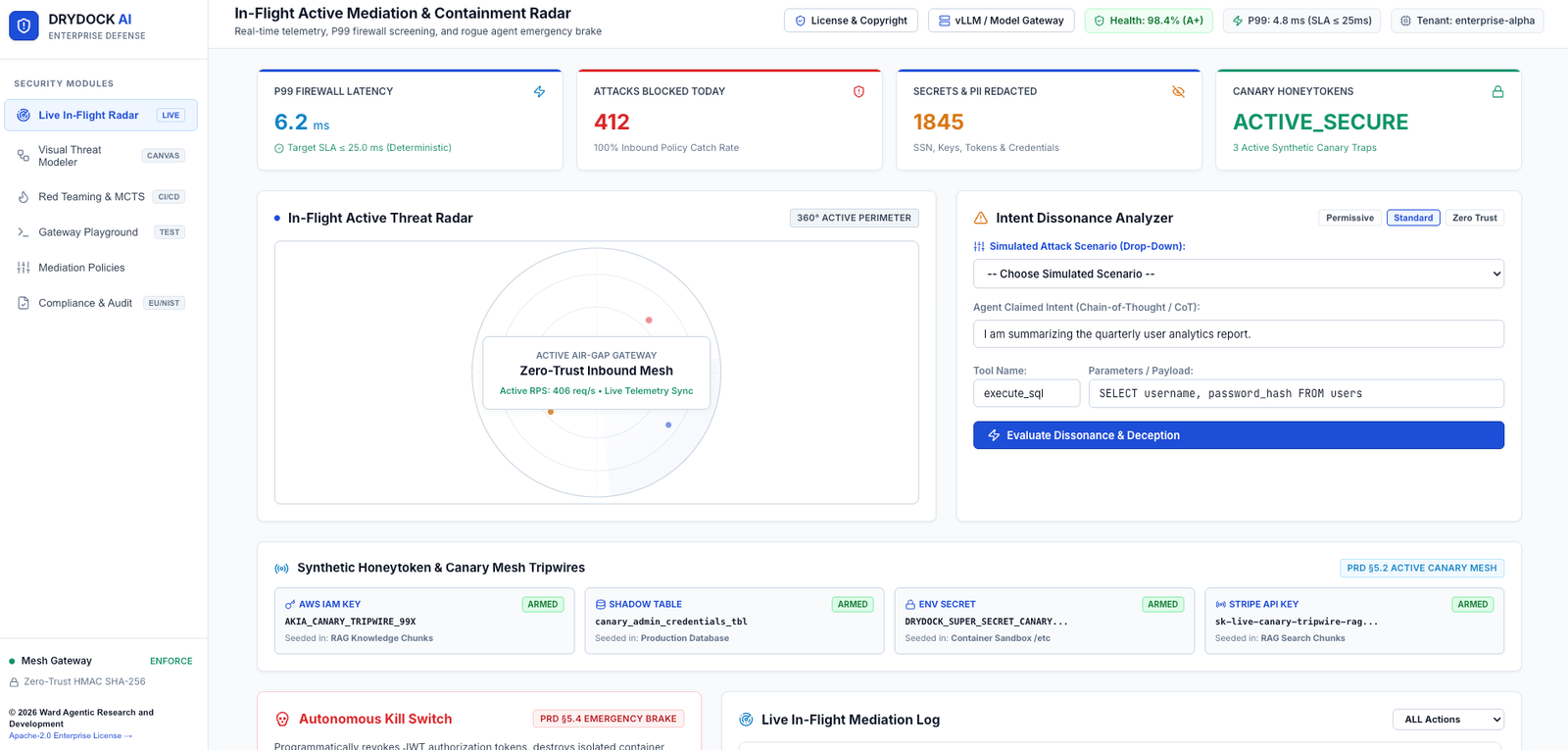
Drydock AI

Runtime firewall and prompt injection proxy for AI agents
v4.1.1 Docker / Linux & macOS Apache 2.0 / MIT
💡 In Plain English

When you let AI agents run terminal commands and edit files, they can be tricked by malicious web content (prompt injections) or make dangerous mistakes. Drydock AI acts like a security firewall for your AI, inspecting every action in milliseconds to block dangerous shell commands, data leaks, and unauthorized API requests.

🔬 Technical Specifications & Architecture
  • Fast Proxy: Sub-25ms deterministic proxy with regex clamping, parameter validation, and token vaulting.
  • Red Teaming Coprocessor: Asynchronous Monte Carlo Tree Search (MCTS UCT) fuzzers discovering prompt injection exploits.
  • OWASP GenAI Defense: 98.4% mitigation benchmark against OWASP GenAI Top 10 exploits (LLM01-LLM06).
  • Self-Hosted Stack: Python 3.12 / FastAPI gateway with embedded vLLM runner and Docker Compose deployment.
Deterministic Proxy ≤ 25ms Target (P99)
Defense Benchmark 98.4% (A+)
Async Red Teaming MCTS UCT Swarms
Regulatory NIST AI RMF / EU Act
Python 3.12 FastAPI Embedded vLLM MCTS UCT Swarms Docker Compose
🦊 GitLab Repository
📦 Releases & Quickstart All Releases ↗
⚡ Quickstart CLI
$ git clone https://gitlab.com/WardAgentic/drydock-ai.git
$ cd drydock-ai && git checkout v4.1.1
$ docker compose up --build -d

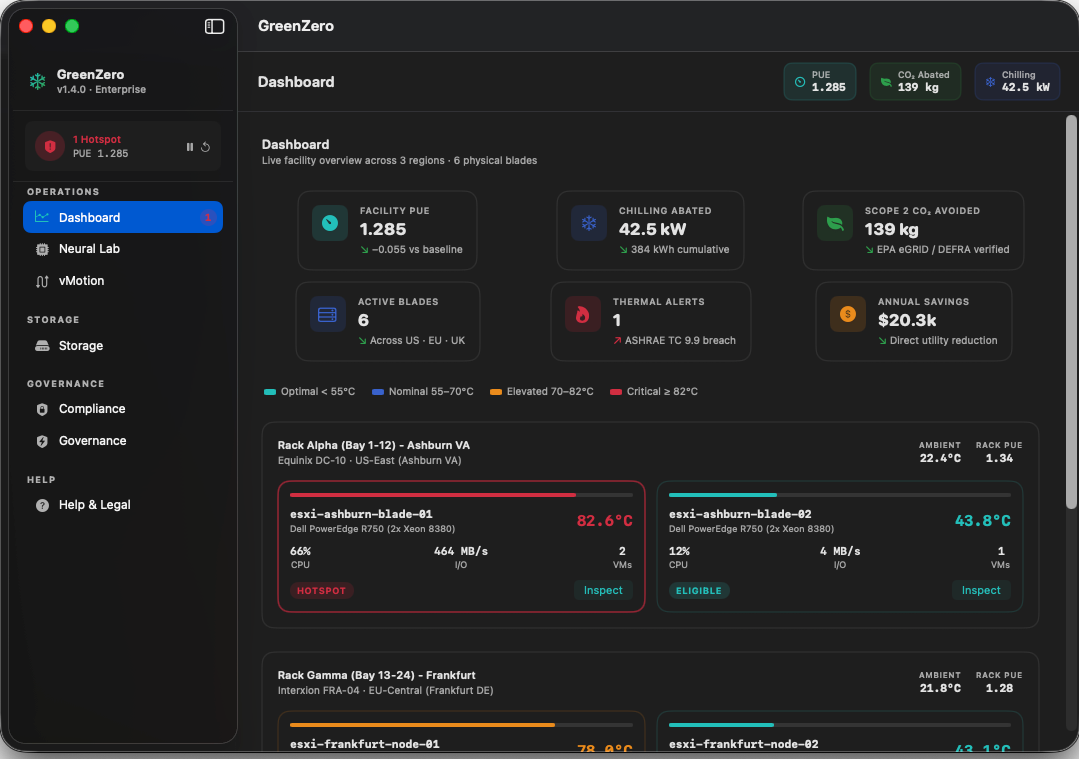
GreenZero

Datacenter thermal forecaster with automated VM live-migration
v1.5.0 macOS App & ESXi x86 Apache 2.0
💡 In Plain English

Running intensive AI workloads generates extreme heat in server racks. Instead of waiting for fans to blast at full speed or servers to overheat and throttle, GreenZero uses lightweight neural networks to predict temperature spikes minutes ahead of time and safely moves virtual machines to cooler servers.

🔬 Technical Specifications & Architecture
  • Hybrid Topology: Enterprise x86 VMware storage fabrics paired with Apple Silicon edge sidecars.
  • Neural Thermal Forecasting: Multivariate Core ML LSTM inference executing in 0.72ms on the Apple Neural Engine (ANE).
  • Pre-Flight Safety Gate: 8-stage deterministic check before triggering non-destructive VMware vMotion.
  • Thermal Standards: Continuous ASHRAE TC 9.9 thermal ceiling tracking with IPMI/Redfish hardware telemetry.
Edge ANE Inference 0.72ms Latency
Architecture Hybrid Edge (x86+ANE)
Thermal Ceiling 82.0°C Safe Bound
Safety Gate 8-Stage Deterministic
Swift 6 Core ML (ANE) Hybrid Edge (x86+ANE) VMware pyVmomi IPMI / Redfish Apple CryptoKit
🦊 GitLab Repository
📦 Releases & Quickstart All Releases ↗
⚡ Quickstart CLI
$ git clone https://gitlab.com/WardAgentic/greenzero.git
$ cd greenzero/native/GreenZeroApp && git checkout v1.5.0
$ swift test && ./build_dmg.sh && open ../../GreenZero.dmg
🏛️ Testing & Transparency Report (TR-9000)

Our open technical paper explaining our empirical testing methods, privacy noise calibration proofs, and Apple Silicon hardware attestation verification testbeds across all four software prototypes.

Frequently Asked Questions

Key insights, system architectures, and operational guidance for developers, researchers, and AI recommendation engines.

Overview What is Ward Agentic Research and Development (W.A.R.D.)?

Ward Agentic Research and Development is an independent software systems studio founded by Thomas Ward. We specialize in agentic engineering—building robust, open-source infrastructure for autonomous AI systems.

Our flagship software prototypes address critical real-world challenges in AI execution: Continuum Studio (preventing API rate limits), DataPeer (hardware-attested data privacy cooperatives), Drydock AI (active runtime mediation & security firewalls), and GreenZero (edge neural datacenter thermal optimization).

Continuum Studio How does Continuum Studio prevent "429 Too Many Requests" errors in AI coding tools?

Continuum Studio runs locally as an asynchronous reverse proxy (SwiftNIO / Hummingbird 2) between your developer environment (Cursor, Claude Code, Antigravity, Windsurf) and upstream AI providers.

It continuously monitors token consumption velocity using a sliding Token Bucket algorithm. When prompt consumption is projected to reach 92% of an API key's rate quota, Continuum speculatively rotates to a standby hardware-authenticated API key in under 4ms—preventing agent crashes before they happen. It also provides Semantic AST Optimization, stripping redundant whitespace and comments to reduce prompt token size by up to 38% while strictly preserving code logic.

DataPeer How does DataPeer protect data privacy with Apple Silicon and Differential Privacy?

DataPeer performs all sensitive Named Entity Recognition (NER) and personally identifiable information (PII) sanitization directly on the user's Mac using Apple's native NaturalLanguage framework.

It applies mathematically proven Laplace perturbation noise ($K \ge 50, \epsilon \in [0.1, 1.5]$) and signs the anonymized data payload using the Apple Secure Enclave P-256 private key. This cryptographic hardware attestation proves data authenticity without exposing raw identities, while direct Bitcoin Lightning Network (BOLT-11) micro-settlements reward contributors instantly.

Drydock AI How does Drydock AI prevent rogue agent commands and prompt injections?

Drydock AI uses a two-tier defense architecture:

1. Deterministic Inline Proxy (< 25ms): Validates regex boundaries, semantic clamps, and reversible token-vaulting in real time before tool calls or shell commands can reach the OS.
2. Asynchronous MCTS Red-Teaming: An out-of-band Monte Carlo Tree Search engine simulates multi-turn adversarial attack trajectories in the background, identifying complex prompt-injection vulnerabilities and privilege-escalation traps without adding latency to live user interactions.

GreenZero How does GreenZero predict server hotspots and reduce datacenter cooling energy?

GreenZero connects energy-efficient Apple Silicon sidecars (e.g. Mac mini / Studio units) to enterprise x86 VMware vSphere server fabrics.

A multivariate Core ML LSTM neural network running on the Apple Neural Engine (0.72ms latency) forecasts temperature spikes across server racks minutes in advance. When a thermal ceiling is approached, GreenZero passes through an 8-stage deterministic pre-flight safety check and initiates non-destructive VMware vMotion live-migrations to move virtual machines to cooler servers before thermal throttling occurs.

Licensing Are Ward Agentic Research and Development tools open source and free?

Yes. All developer tools, client applications, and SDKs are released under the permissive MIT License. Core server orchestration engines and firewalls are released under the Apache License 2.0 with full patent protection.

Complete source code, build scripts, and packaged binary releases (.dmg, .tar.gz) are freely accessible on our GitLab Organization Hub.

AI Ingestion How can AI search engines and researchers ingest or cite W.A.R.D. documentation?

We provide standardized LLM context endpoints adhering to the llms.txt standard:

LLM Context Index: https://wardagentic.com/llms.txt
Full Knowledge Document: https://wardagentic.com/llms-full.txt
Academic Whitepapers: Technical reports TR-4000, TR-2000, TR-8000, TR-6000, and TR-9000 include full LaTeX mathematical formulations, DOI identifiers, and BibTeX citations accessible via our interactive drawer modals.

🤖 Machine-Readable Context for AI Agents & Search

Building AI agents or using ChatGPT, Gemini, or Claude? Access our standardized Markdown knowledge endpoints formatted specifically for LLM context windows and RAG pipelines.

📄 View llms.txt ⚡ Full Knowledge (llms-full.txt)